
The Jews and the Left
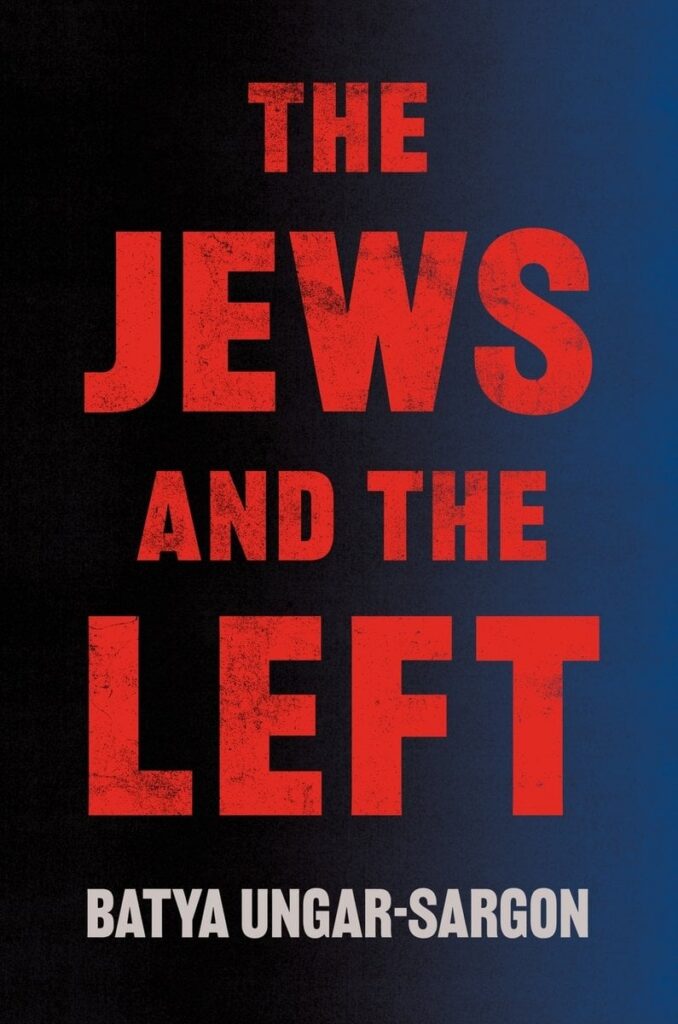
The Jews and the Left, by Batya Ungar-Sargon (New York: Broadside Books, 2026)
Reviewed by Steven Davis
In their ascent to prosperity in America, Jews endured humble and exploitative circumstances. As they moved into the middle class and left their garment center origins, they supported social, liberal causes. But then, as the left became more radical, Jewish people found themselves being minimalized and even excluded from the causes they actively supported.
The author deftly manages this troubled history in an exacting survey of the Jewish experience in America beginning with President Washington’s assurance to early immigrants and to minority religious groups that they were welcome here with equal privileges as long as they aspired to become good citizens. (However, the author’s positive views of the Jews’ formal equality in American history underplay a significant history of social, informal prejudice, and nativist prejudice that led to a cutoff of most immigration in 1924.)
The late 1800’s and the early 20th century saw a mass immigration of Jews from Eastern Europe. They settled mostly in the major Eastern cities and, because of their experience as tailors, gravitated to the needle trades. They experienced low wages, long hours, unclean factory settings and dilapidated tenement housing. They organized labor unions and achieved improvements in the “Uprising of the 20,000.” The Triangle Shirt Waist Factory Fire in 1911 in which 146 mostly Jewish women and girls died, also spurred the formation of labor unions in which Jews were members and leaders.
The liberalism and social activism of the early unions and their members led to the establishment of pensions, co-operative housing and health clinics. They enthusiastically supported the broad-minded openness of Roosevelt’s New Deal and became strongly attached to the Democratic Party.
Later, as they moved from factory work into the middle class, Jews supported justice and equality in American society and enthusiastically became leaders in and supported the Civil Rights Movement, the LBGTQ effort and the Women’s Liberation movement. Activism in the 1950’s and 1960’s sought to and caused Americans to unite people with different racial, religious and sexual beliefs. Political liberalism of American Jews emanates from the liberalism of Jewish tradition, i.e., the more secularized elements of the Jewish population.
However, the author notes that by the 1980’s activism by the Left had changed. The Black Power movement “shattered the ideal of one America” and was replaced with the concept of race identification and “identity politics.” The author states that identity groups used claims of oppression as a “form of power” to exact demands on institutions.
Zionists and pro-Israel Jews were excluded by left wing groups whereas previously they were enthusiastically included. Jewish people, once persecuted, were encouraged to believe that they were now considered wealthy, privileged oppressors. Their support for Israel and Zionism was undermined by the events of October 7 and thereafter, with Jews, once strong supporters of Israel, now sympathizing more with Palestinians than with Israelis in a “shocking reversal that took place in less than one decade.” Now Jews and Israelis are viewed as the conquering army, colonialists and aggressors.
On American college campuses and in other venues, some American Jews view Israel as an occupying army instead of celebrating Israel’s strength. They excuse overt antisemitism. The author notes that programs in African American Studies, affirmative action in hiring at universities and the professions, teaching and medicine, are examples of the Left’s influence in society.
The book is an arresting view of how many American Jews once viewed themselves as supporters of Liberalism and Israel, and how the Left now sees that group in a far different light. How Jews should respond politically is not stated, although perhaps implied, and the author does not review her own political transition from Liberal to “MAGA-Leftist.” It remains to be seen whether Jews driven out by an “anti-Zionist Left” can find a home on the Right if it becomes dominated by “Christian Nationalism” and “Heritage Americans,” or if the Jews will revert to a role familiar to them in history, the Outsider.
Reviewed by Steven Davis, a member of the Executive Board of the New York Labor History Association and a retired Administrative Law Judge with the National Labor Relations Board.